A unique peer-reviewed study opens a new chapter in vaccine research. The study addresses the “untouchable” controversial issue that has been the intensely disputed for more than twenty-five years. It set out to examine whether the CDC Childhood Vaccination Schedule is safe; or whether vaccines contribute to the epidemic of neurodevelopmental illnesses among children. The two-part study of 666 children in four states in the US, was conducted by an independent team of researchers from the Department of Epidemiology and Biostatistics, Jackson State University, Mississippi.
Vaccinations have prevented millions of infectious illnesses, hospitalizations and deaths among U.S. children, yet the long-term health outcomes of the vaccination schedule remain uncertain. Studies have been recommended by the U.S. Institute of Medicine to address this question. This study aimed 1) to compare vaccinated and unvaccinated children on a broad range of health outcomes, and 2) to determine whether an association found between vaccination and neurodevelopmental disorders (NDD), if any, remained significant after adjustment for other measured factors.
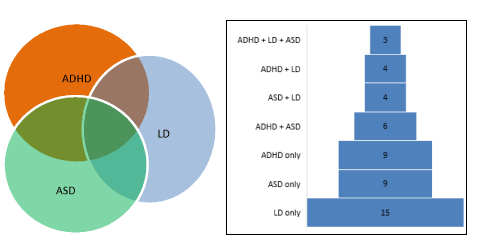
A cross-sectional study of mothers of children educated at home was carried out in collaboration with homeschool organizations in four U.S. states: Florida, Louisiana, Mississippi and Oregon. Mothers were asked to complete an anonymous online questionnaire on their 6- to 12-year-old biological children with respect to pregnancy-related factors, birth history, vaccinations, physician-diagnosed illnesses, medications used, and health services. NDD, a derived diagnostic measure, was defined as having one or more of the following three closely-related diagnoses: a learning disability, Attention Deficient Hyperactivity Disorder, and Autism Spectrum Disorder.
A convenience sample of 666 children was obtained, of which 261 (39%) were unvaccinated. The vaccinated were less likely than the unvaccinated to have been diagnosed with chickenpox and pertussis, but more likely to have been diagnosed with pneumonia, otitis media, allergies and NDD. After adjustment, vaccination, male gender, and preterm birth remained significantly associated with NDD. However, in a final adjusted model with interaction, vaccination but not preterm birth remained associated with NDD, while the interaction of preterm birth and vaccination was associated with a 6.6-fold increased odds of NDD (95% CI: 2.8, 15.5).
In conclusion, vaccinated homeschool children were found to have a higher rate of allergies and NDD than unvaccinated homeschool children. While vaccination remained significantly associated with NDD after controlling for other factors, preterm birth coupled with vaccination was associated with an apparent synergistic increase in the odds of NDD. Further research involving larger, independent samples and stronger research designs is needed to verify and understand these unexpected findings in order to optimize the impact of vaccines on children’s health.
This important report has been pulled from the website with no explanation. You can read it
From about 8% to 27% of extremely preterm infants develop symptoms of autism spectrum disorder, but the causes are not well understood. Preterm infants receive the same doses of the recommended vaccines and on the same schedule as term infants.
The possible role of vaccination in neurodevelopmental disorders (NDD) among premature infants is unknown, in part because pre-licensure clinical trials of pediatric vaccines have excluded ex-preterm infants. This paper explores the association between preterm birth, vaccination and NDD, based on a secondary analysis of data from an anonymous survey of mothers, comparing the birth history and health outcomes of vaccinated and unvaccinated homeschool children 6 to 12 years of age.
A convenience sample of 666 children was obtained, of which 261 (39%) were unvaccinated, 7.5% had an NDD (defined as a learning disability, Attention Deficit Hyperactivity Disorder and/or Autism Spectrum Disorder), and 7.7% were born preterm.
No association was found between preterm birth and NDD in the absence of vaccination, but vaccination was significantly associated with NDD in children born at term (OR 2.7, 95% CI: 1.2, 6.0). However, vaccination coupled with preterm birth was associated with increasing odds of NDD, ranging from 5.4 (95% CI: 2.5, 11.9) compared to vaccinated but non-preterm children, to 14.5 (95% CI: 5.4, 38.7) compared to children who were neither preterm nor vaccinated.
The results of this pilot study suggest clues to the epidemiology and causation of NDD but question the safety of current vaccination practices for preterm infants. Further research is needed to validate and investigate these associations in order to optimize the impact of vaccines on children’s health.
Overlap & distribution of physician-diagnosed NDD
The report has been pulled from the website with no explanation. You can read it here
Steven Fiorello, former Chief Pharmacist for the State of Pennsylvania, was arraigned on on Tuesday, November 21, 2006, on Felony and Misdemeanor charges related to his accepting money from drug companies whose drugs he put on the state Formulary.
Part 4. Maiming with Myocarditis Both of the two US monkeypox/smallpox vaccines (Jynneos and ACAM2000) are known to cause myocarditis, as do all 3 COVID vaccines currently available in the US: the Pfizer and Moderna COVID-19 mRNA vaccines and the Novavax vaccine. The Novavax vaccine was first associated with myocarditis…
The good news is that Covid-19 is losing its epidemic status because of the continuing decline in the number of deaths from |Covid-19 and pneumonia, as confirmed by the CDC on July 3rd: “Based on death certificate data, the percentage of deaths attributed to pneumonia, influenza or COVID-19 (PIC) decreased…
This is a developing news story focusing on the corruption of industry-initiated government vaccination policies. The case involves Sanofi and the launching of its Dengvaxia vaccine in a massive school-based Dengvaxia vaccination campaign in 830,000 Philippino school children. The New York Times has just published its report, noting that: “public health…
CDC is petrified that the revelations made by Dr. William Thompson the CDC whistleblower, in taped recordings – a portion of which are presented in the riveting film, VAXXED: From Corruption to Catastrophe, are but a prologue of revelations to come. CDC is petrified of facing Dr. Thompson in a congressional hearing which would…
A growing Crisis: Aggressive Marketing of drugs for children_Lou Dobbs-CNN Fri, 3 Oct 2003 CNN’s anchor Lou Dobbs, an astute business journalist whose program Lou Dobbs Tonight on CNN examines politics, the economy and a broad range of issues that affect the quality of life and standard of living of…



Loading...

 Reload document
  Open in new tab