William C Black MD conducted unethical medical experiments on children. He wrote a report about an experiment in which he had infected a 12-month old baby with herpes. Francis Payton Rous, editor of the Journal of Experimental Medicine, rejected Black’s manuscript and wrote an editorial in the Journal stating:
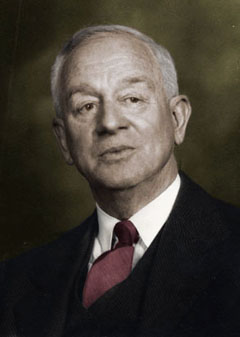
Dr. Payton Rous 1966 Nobel Prize Winner
“I cannot let this occasion pass without saying that in my personal view th inoculation of a twelve month old infant with herpes virus obtained from an adult was an abuse of power, an infringement of the rights of an individual, and not excusable because the illness which followed had implications for science. The statement that the child was ‘offered as a volunteer’ – whatever that may mean – does not palliate the action.(Rous, 1941, quoted by Michael Grodin and Leonard Glanz. Children as Research Subjects: Science, Ethics, and Law, 1994)
Nevertheless, Black published his report in the Journal of Pediatrics, 1942. Black selected at random, 23 children from his patients and injected them with infected herpes tissues to demonstrate symptoms that were caused by a single herpes virus. (Timothy Murphy. The Ethics of Research with Children, AMA, 2003)
Dr. Rous received the Nobel prize 50 years after he discovered the transmittable virus causing sarcoma cancer in chickens, but his discovery had been rejected by most pathologists. For about forty years his momentous discovery had little impact, because scientists were not prepared to think of viruses as agents of cancer.
Arthur Wentworth, MD, a pediatrician trained at Harvard Medical School, performed spinal taps on 29 babies and young children at Children’s Hospital, Boston, to determine if the procedure was harmful. Dr. John Roberts of Philadelphia, noting the non-therapeutic indication, labeled Wentworth’s procedures “human vivisection.” (Grodin and Glantz, Children As Research…
U.S. Supreme Court upheld a Virginia forced sterilization statute of people considered “genetically unfit.” Harvard-educated eugenicist, Oliver Wendell Holmes’ infamous declaration, “Three generations of imbeciles are enough. . .” resulted in the forced sterilization not only of Carrie Buck of Charlottesville, Virginia, who was falsely “diagnosed” as mentally deficient and…
Alfred Hess & Mildred Fish used orphans as guinea pigs in studies testing dietary factors in rickets and scurvy by withholding essential nutrients from institutionalized infants until they developed the disease. Orange juice was withheld until the infants developed hemorrhages associated with Scurvy. Konrad Bercovici, a social worker, strongly criticized…
U.S. Public Health Service begins a 25-year Syphilis experiment at Tuskegee, Alabama, involving 400 black sharecroppers. The purpose of the experiment was to study the natural course of untreated syphilis in Negro men. Notwithstanding the participation of black institutions, doctors and the pivotal nurse Eunice Rivers, the underlying premise of…
Cornelius Rhoads, MD, a prominent, Harvard trained pathologist conducted a cancer experiment in Puerto Rico under the auspices of the Rockefeller Institute for Medical Investigations resulting in the death of thirteen subjects. He was accused of purposely infecting his Puerto Rican subjects with cancer cells after a Puerto Rican physician…
“Leaders of the American Medical Association briefly considered amending the organization’s code of ethics to include the provision that human experimentation calling for the knowledgeable permission of the subject. The AMA leadership decided not to adopt such a stance believing it both unnecessary in light of the good moral character…